Introduction
In this document we will describe the Active Engine product implemented in White Label mode. In this case Fabrick adds a layer of abstraction, allowing the TPP to remove any kind of implementation logic and focus mainly on the graphical aspect. In particular, the White Label solution provides a standard UI that can be customized by the TPP by simply modifying certain aspects of the CSS, such as:
- The company logo
- The font (type, weight, size)
- The style
The management of the various SCA flows (Redirect, Embedded, Decoupled) along with their various extensions will therefore be entirely handled by Fabrick, thus guaranteeing 100% coverage of the banks exposed by Fabrick. Another advantage worth highlighting concerns maintenance: any type of update / change on the banks' side (flow change, gateway change, bank mergers, etc.) will be managed by Fabrick, allowing TPPs to inherit these revisions in total transparency.
Fabrick PSD2 Active Engine is a services platform that includes:
- Account aggregation (AIS)
- Payment initiation (PIS)
All operations are guaranteed with the utmost respect for security and privacy.
The entities that can access the platform are defined as TPP (Third Party Providers) and can be of three types, as established by the PSD2 regulation:
- AISP (Account Information Service Provider)
- PISP (Payment Initiation Service Provider)
- PIISP (Payment Instrument Issuer Service Provider)
This document describes the features related to AISP and PISP.
AISP providers can connect to bank accounts to retrieve information needed for various purposes.
PISP providers allow a payment to be initiated from an account to a beneficiary without using a credit card, simply by entering the information needed for the transfer.
Use case
Today every bank allows its customers to access data through an Internet Banking portal in order to:
- View the balance
- Check the latest transactions
- Carry out operations (e.g. bank transfers)
If a user holds accounts at multiple financial institutions, it is not possible to have an aggregated view.
Through the Active Engine, the end consumer can:
- Have a comprehensive view of their financial situation
- Analyze spending habits
- Assess future financial needs
- Make SEPA payments from any personal account
All while remaining within the same user interface.
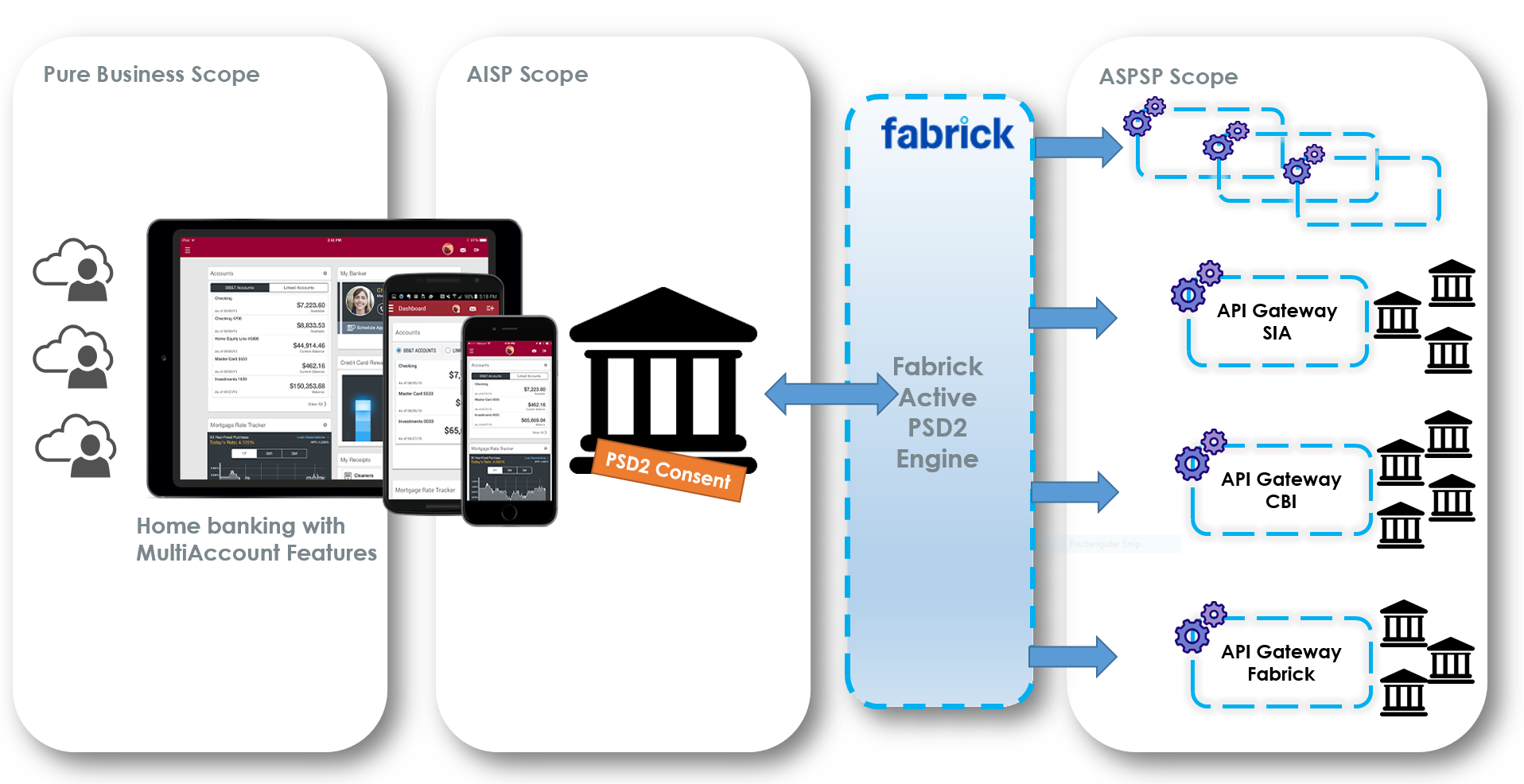
The Active Engine sits between the TPP and the various gateways, each of which groups together one or more ASPSPs.
To use the platform's services, a few preliminary steps must be completed.
Becoming a TPP
It is necessary to obtain authorization from the Bank of Italy in order to operate as a TPP (AISP and/or PISP).
The procedure is similar to that required for banking or financial institutions, with some simplifications.
During the process, the following requirements are verified:
- Adoption of an admitted corporate form (S.p.A., S.r.l., cooperative, etc.)
- Presence of the registered office and head office in Italy
- Submission of a business activity program and business plan
- Adequate organizational structure
- Integrity requirements for directors and executives (Art. 26 TUB)
- Civil liability insurance policy
- Absence of impediments to supervision
The Bank of Italy grants or denies authorization within 90 days from receipt of the complete application.
After registration in the register provided for under Art. 114-septies TUB, the TPP can begin operating.
Banking institutions are already authorized to provide the services required for TPPs under the PSD2 regulation.
Obtaining QWAC and QSealC certificates
PSD2 opens up access to banking data to third parties, making it essential to ensure security and integrity in communications.
TPPs must obtain the certificates required by the eIDAS standard.
QWAC (Qualified Web Authentication Certificate)
A qualified SSL certificate required to ensure secure and authenticated communications between the TPP and the ASPSP.
QSealC (Qualified Certificate for Electronic Seal)
A certificate for electronic seal that guarantees:
- Data integrity
- Origin of the information
- Authenticity of the organization
Unlike a personal digital signature, it identifies the organization.
Fabrick offers a certificate management service on behalf of the TPP, handling the entire process with the Trust Service Provider (e.g. InfoCert).